

Why Your Car AC Blows Warm Air After Adding Refrigerant

Last Updated: November 12, 2026
Quick Summary
Car AC warm air after adding refrigerant usually means the system has a leak, is overcharged, or has a failed component rather than a simple shortage. Refrigerant is a sealed system's fuel, not its fix, so topping off without finding the leak only buys a few weeks of cold air.
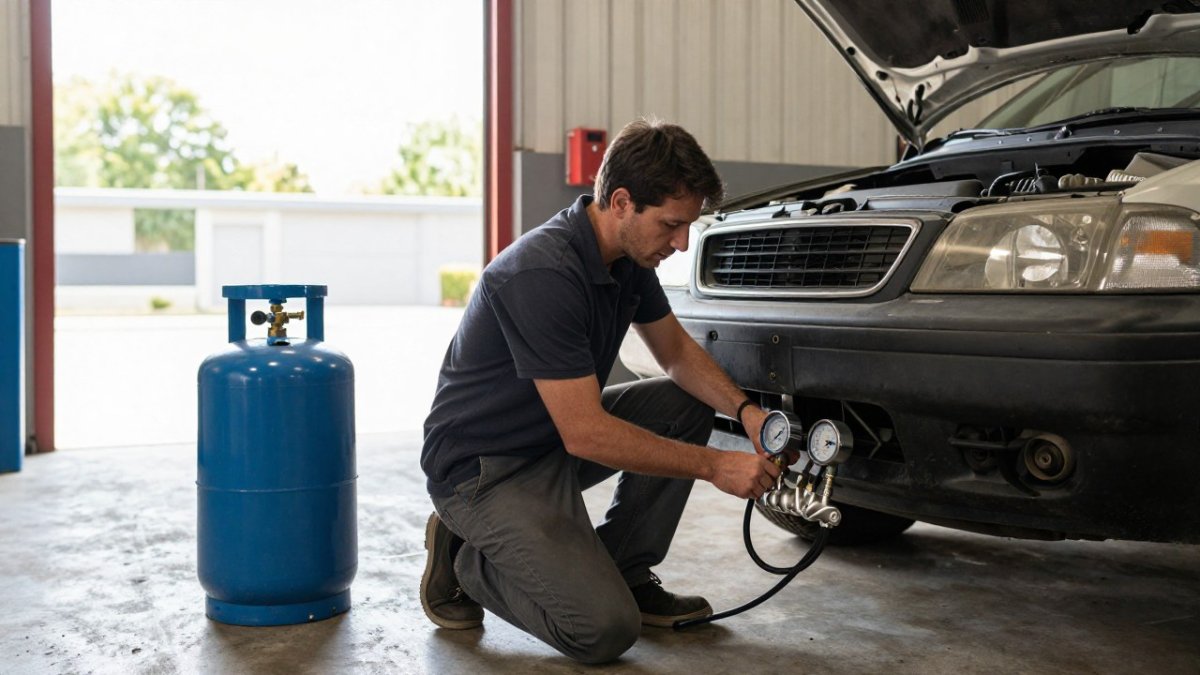
Hook up a manifold gauge set and read both sides with the engine running and the AC on max.
Both gauges low with the compressor cycling quickly means the system is still losing refrigerant.
An overcharge floods the condenser, raises head pressure, and can slug the compressor with liquid.
A clogged expansion valve starves the evaporator, so vents blow warm even with a full charge.
If pressures are normal but vents are warm, check the clutch, condenser fan, cabin filter, and blend door.
Still blowing warm after a recharge?
We stock R134a, R1234yf, and the tools to finish the repair right.
Table of Contents
Car AC Blowing Warm Air but Full of Refrigerant: What That Really Means
Car AC Overcharged Symptoms and Why Too Much Refrigerant Backfires
Car AC Compressor Not Engaging: Clutch, Fuse, and Pressure Switch Checks
Car AC Blowing Hot Air When Stopped: Airflow and Condenser Problems
A Step-by-Step Diagnostic Sequence for Warm Air After a Recharge
Why Adding Refrigerant Didn't Fix Your Car AC
You added refrigerant, and the vents still blow car AC warm air.
Here's the core problem: refrigerant is a sealed system's fuel, not its fix. If the charge was low, it escaped somewhere.
Best Refrigerant supplies R134a and R1234yf for automotive and HVAC work. Below, we'll show you how to diagnose a car AC warm air complaint step by step, starting with pressure.
Car AC Blowing Warm Air but Full of Refrigerant: What That Really Means
A car AC blowing warm air but full of refrigerant means the system has charge but cannot convert it into cold air. The fault sits in pressure, flow, or control, not in the refrigerant quantity itself.
That distinction matters. Adding more gas to a system that is already full makes things worse, not better. It raises head pressure, stresses the compressor, and can cut cooling entirely.
Check System Pressure Before Anything Else
Hook up a manifold gauge set and read both sides with the engine running and the AC on max. Static pressure tells you almost nothing; running pressures tell the story.
Both sides low: the system is undercharged or leaking.
Both sides high: overcharge or poor condenser airflow.
Low side high, high side low: a failing compressor.
Compare your readings to the vehicle's underhood label. That label is the authority, not a generic chart.
Look for Refrigerant Leaks With UV Dye or an Electronic Detector
Most low-charge complaints trace back to a leak at a fitting, O-ring, Schrader valve, or condenser. UV dye and an electronic sniffer both find it fast.
Shine a UV light along every joint, hose crimp, and service port after the system runs. Dye glows green or yellow at the escape point. An electronic detector picks up refrigerant in the air near a slow leak that dye has not reached yet.
For a deeper walkthrough of the process, our guide on spotting car AC leaks fast covers each test in detail. If you want to combine sealing with detection, a ProSeal can with leak detector adds UV dye and sealer in one step for minor leaks.
Car AC Overcharged Symptoms and Why Too Much Refrigerant Backfires
Car AC overcharged symptoms show up fast: weak cooling, a compressor that short-cycles, and high-side pressure that climbs past spec. Too much refrigerant floods the condenser, and the system loses its ability to reject heat.
Watch for these signs:
The compressor clutch engages and disengages every few seconds
Vent air feels cool at idle and warm in traffic
The high-side hose is hot and hard
An overcharged system is not a minor issue. Liquid refrigerant can slug the compressor and destroy it. If your gauges show an overcharge, recover the excess to the correct weight before driving further.
Car AC Compressor Not Engaging: Clutch, Fuse, and Pressure Switch Checks
A car AC compressor not engaging usually means the clutch is not receiving power, a fuse is blown, or a pressure switch has cut the circuit.

Start at the fuse box and confirm the AC fuse and relay are good. Then check the clutch connector for voltage with the AC commanded on.
A high-pressure switch opens on overpressure, and a low-pressure switch opens when charge drops. Either one cuts the clutch to protect the system.
If the clutch still will not pull in, our guide on how to tell if your AC compressor is bad helps separate a dead clutch from a seized compressor before you buy parts.
Car AC Blowing Hot Air When Stopped: Airflow and Condenser Problems
Car AC blowing hot air when stopped points at airflow. At a red light there is no ram air through the condenser, so a weak fan or a clogged condenser shows up as warm vents at idle and cold air once you drive.
Hot, humid conditions make this worse, because high ambient temperatures push the condenser hard and a marginal fan is more likely to fail under that load.
Cooling Fan and Condenser Airflow Tests
Watch the condenser fan with the AC on and the car parked. It should run whenever the compressor runs. If it stays still, check the fan relay, the fan motor, and its connector.
Then look at the condenser face. Bugs, leaves, and road grime block fins and kill heat transfer. Rinse it from behind with low pressure, never blast it from the front.
Cabin Airflow, Blower, and Cabin Air Filter Checks
Weak airflow from the vents is a separate problem from warm refrigerant. A clogged cabin air filter chokes the blower, and a failing blower motor resistor drops fan speed.
Pull the cabin filter and hold it to the light. If you cannot see through it, replace it.
Run the blower on each speed. No change between settings points to the resistor.
Check that the blend door moves. A stuck door sends air through the heater core year-round.
Expansion Valve and Metering Device Restrictions
A clogged expansion valve starves the evaporator, and the vents blow warm even with a full charge. The valve meters liquid refrigerant into the evaporator; when it sticks closed or plugs with debris, no cooling happens.
Symptoms of a restriction:
Low side pulls into a vacuum while the high side runs high
The expansion valve frosts over or sweats unevenly
Cooling fades after the system runs a few minutes
Debris from a failing compressor or a dessicant bag that broke apart often causes the clog. Replacing the valve without flushing the system invites the same failure again.
A Step-by-Step Diagnostic Sequence for Warm Air After a Recharge
Most guides list causes. This one gives you an ordered process built specifically for the complaint that cooling did not return after a recharge, so you can tell an undercharge, an overcharge, a leak, and an unrelated fault apart before you spend money.
Work in order and stop when a test fails. Run every test with the engine at operating temperature, the AC on max, blower on high, and doors open. Record each reading, patterns across steps reveal the fault faster than any single number.
Step | Check | Tool | Passing Result | If It Fails |
1 | Confirm refrigerant type and spec charge weight | Underhood label | Label matches what was added | Recover and recharge to label weight |
2 | Running pressures at 1,500-2,000 rpm | Manifold gauge set | Within label or service-manual range | Go to Step 3 |
3 | Static and running leak test | UV dye, electronic detector, or nitrogen pressure test | No dye glow, no detector alarm, pressure holds | Repair leak, evacuate, recharge |
4 | Compressor clutch engagement | Multimeter and visual | Clutch engages with AC commanded on | Test fuse, relay, pressure switch, PCM signal |
5 | Condenser fan operation | Visual and voltage | Fan runs whenever compressor runs | Replace fan, relay, or motor |
6 | Cabin filter and blower speeds | Visual and hand test | All speeds work, filter passes light | Replace filter or blower resistor |
7 | Blend door and temperature control | Visual and actuator test | Door moves through full travel | Replace actuator or repair door |
8 | Expansion valve and orifice tube | Gauge readings and temperature drop | Low side cold, high side hot, evaporator evenly cold | Replace valve or tube, flush system |
How to Read the Results After a Recharge
The most common post-recharge pattern is both gauges low with the compressor cycling quickly. That means the system is still losing refrigerant, the recharge masked a leak, and the new charge escaped.
Watch out: do not add more refrigerant to a system that already shows normal or high pressures. Overcharging raises head pressure, can slug the compressor with liquid, and may open the high-pressure switch so the clutch never engages.
What to Do When the Sequence Points to a Leak
If Step 3 fails, stop. Adding refrigerant to a leaking system is a temporary fix at best. The correct repair is to find the leak, repair or replace the failed component, evacuate the system with a recovery machine, and recharge by weight to the underhood label. A system that has been open to the atmosphere for an extended period may also need a new receiver-drier or accumulator, because the desiccant absorbs moisture.
When the Problem Is Not the Refrigerant at All
If Steps 1 through 3 pass and pressures are normal, the refrigerant is not your problem. Move to Steps 4 through 8. A compressor clutch that never engages, a condenser fan that never runs, a clogged cabin filter, a stuck blend door, or a restricted expansion valve will all produce warm vents with a perfectly charged system. This is the most common reason a recharge appears to fail, the recharge was never the fix.
Vehicle Versus Home AC: Know Which System You Have
This guide covers car and light-truck AC systems. If you are troubleshooting a home or apartment air conditioner, the checks are different: look at the outdoor condenser unit, the air filter, the thermostat batteries and settings, and the breaker. Do not add automotive refrigerant to a residential system, and do not use residential gauges on a vehicle. The two systems use different refrigerants, pressures, and service procedures.
Ordering the Right Refrigerant and Parts for the Repair
Once you know the fault, order the correct refrigerant and parts the first time. R134a and R1234yf do not mix, and using the wrong gas ruins the repair.
Check the underhood label for the refrigerant type and charge weight. A 134a recharge hose with top tap fits standard cans and makes a top-off or sealer job clean. For a full parts list, our guide to buying AC parts online covers what to source before you start.
Best Refrigerant stocks hundreds of products with same-day shipping on weekday orders, and packs orders with care to protect them in transit.
Warm air after a recharge is a diagnosis problem, not a refrigerant problem.
Frequently Asked Questions
Why is my car AC blowing warm air after adding refrigerant?
Adding refrigerant only fixes warm air if the system was low and nothing else failed. If the car AC warm air persists after a recharge, the usual causes are a refrigerant leak that let the charge escape again, an overcharged system that trips the high-pressure switch, a compressor that is not engaging, or restricted airflow across the condenser. Check system pressure with a gauge set first, then inspect for leaks and confirm the compressor clutch engages before adding more refrigerant.
Can adding too much refrigerant make car AC blow warm air?
Yes. An overcharged system raises head pressure and can cause the compressor to cycle off or the high-pressure switch to cut it out, which leaves you with warm air. Common car AC overcharged symptoms include the compressor short-cycling, high vent temperatures at idle, and unusually high readings on the high-side gauge. If pressure is above the manufacturer's specification, recover the excess refrigerant with a recovery machine rather than venting it, then recharge to the exact weight or pressure the service manual lists.
Why does my car AC blow hot air when stopped but cold air while driving?
That pattern points to airflow across the condenser. When the car is moving, ram air cools the condenser even if the electric cooling fan is weak or dead. At a stop, the fan has to do all the work, so a failed fan, a blown fuse, or a condenser packed with debris lets head pressure climb and cooling performance drop. Check that the cooling fan runs with the AC on, inspect the condenser fins for bugs and road grime, and confirm the radiator and condenser are not blocked.
Should I keep driving if my car AC is blowing warm air after a recharge?
You can drive the car, but running the AC with a known leak or an overcharged system puts extra load on the compressor and can turn a cheap repair into an expensive one. If the compressor is noisy, the clutch is slipping, or the high-side pressure is far above spec, turn the AC off and have the system diagnosed. A proper leak detection and repair, followed by a recharge to the exact specification, is the only fix that lasts.


Comments